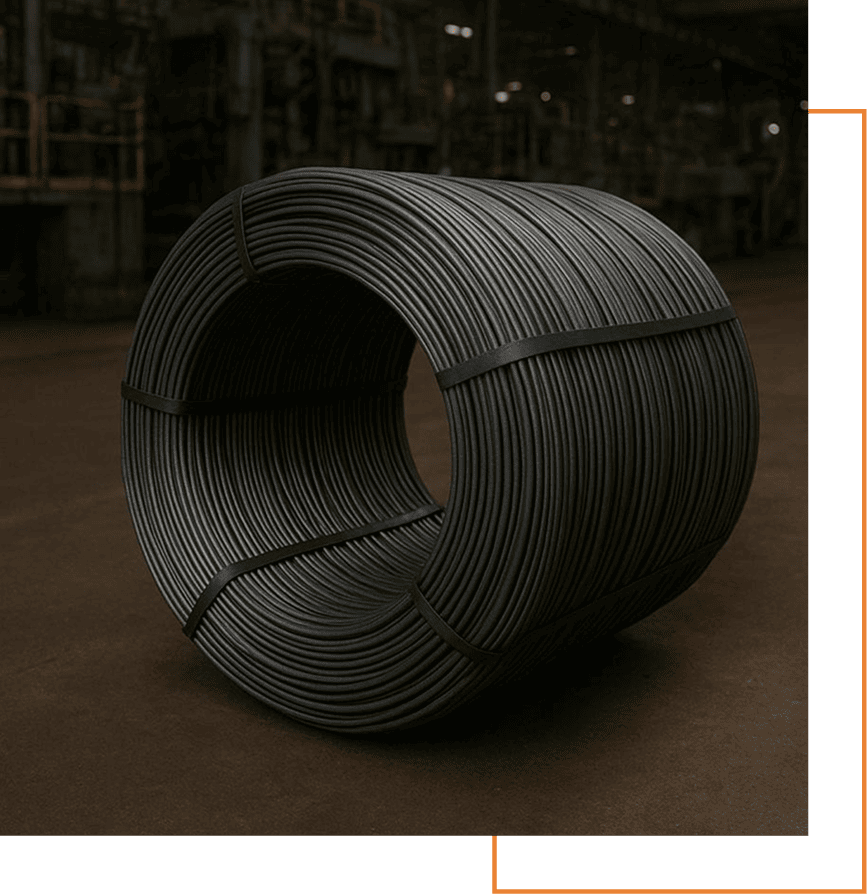
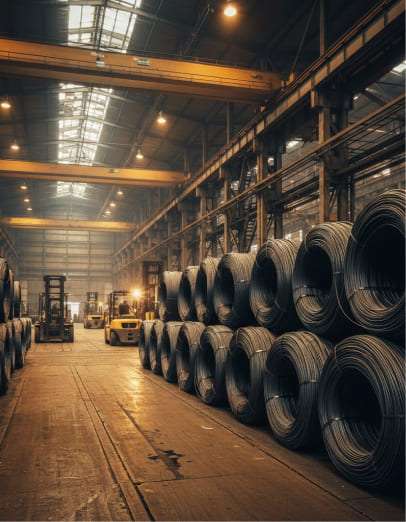
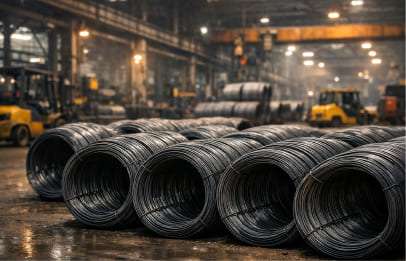
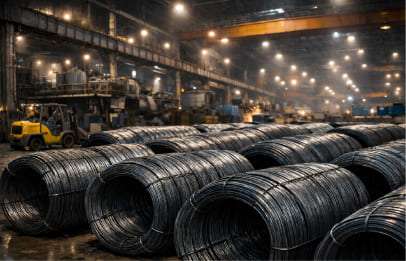
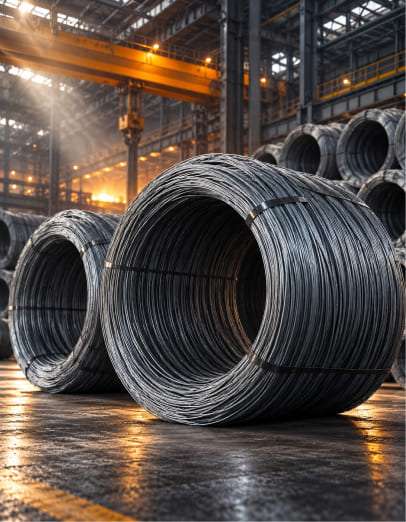
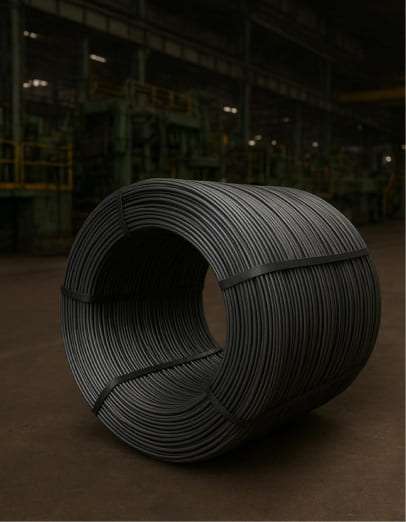
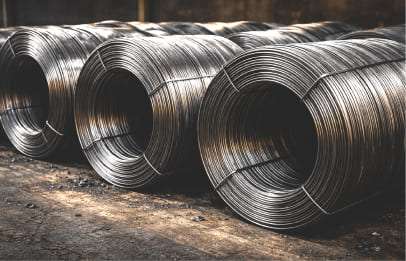
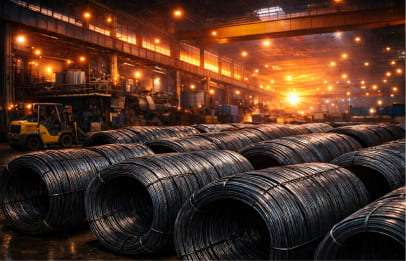
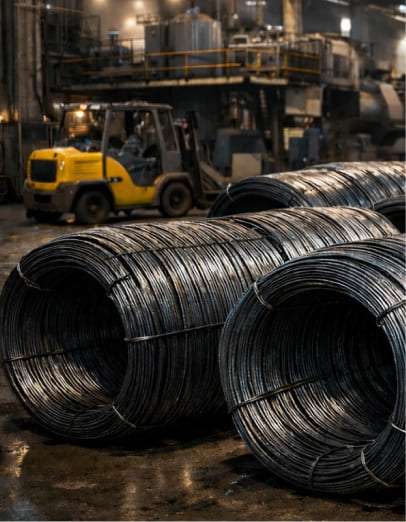
Following the production of billets through the continuous casting process, hot billets are directly transferred to our wire rod mill through a hot charging process, which reduces heat loss and improves energy efficiency. The billets are then passed through a series of rolling stands where they are progressively reduced in cross-section and rolled into wire rods of the desired dimensions. The wire rods are subsequently cooled, wound into coils and prepared for dispatch.
Manufacturing Process: We use a combination of iron ore, non-coking coal, and dolomite in a rotary kiln to produce dust-free sponge iron.
Reduction Process: The reduction occurs in a solid state at temperatures between 850-1100°C. Coal is used both as a reductant and a heat source.
Quality Assurance: We adhere to strict standards to ensure each batch of sponge iron supports industry safety and efficiency.
Properties
Key Properties of Sponge Iron
High degree of metallization
Ensures superior quality and performance.
Lower sulphur and phosphorus content
Each batch meets stringent uniformity standards.
Uniform and consistent quality
Minimizes impurities for better steel quality.
Minimal Dust Production
Enhances safety and reduces cleanup during handling.
Chemical properties
Elements
Sponge Iron Lumps
Sponge Iron Fines
Fe (M)
80 ± 2%
80 ± 2%
Fe (T)
90 ± 2%
80 ± 2%
Mtz %
88 ± 2%
80 ± 2%
p
0.06%
80 ± 2%
s
0.03%
0.04%
c
0.10-0.25%
0.25-0.35%
Non-magnetic
0.8% (max.)
1% (max.)
Sio2 + Al2O3
6% (max.)
806% (max.)
Sio2 + Al2O3
6% (max.)
6% (max.)
Cao + Mgo
6% (max.)
1% (max.)
Size(mm)
3 to 2
0 – 4 mm
Our Production in Pictures
A Closer Look at the Processes That Define Our Excellence